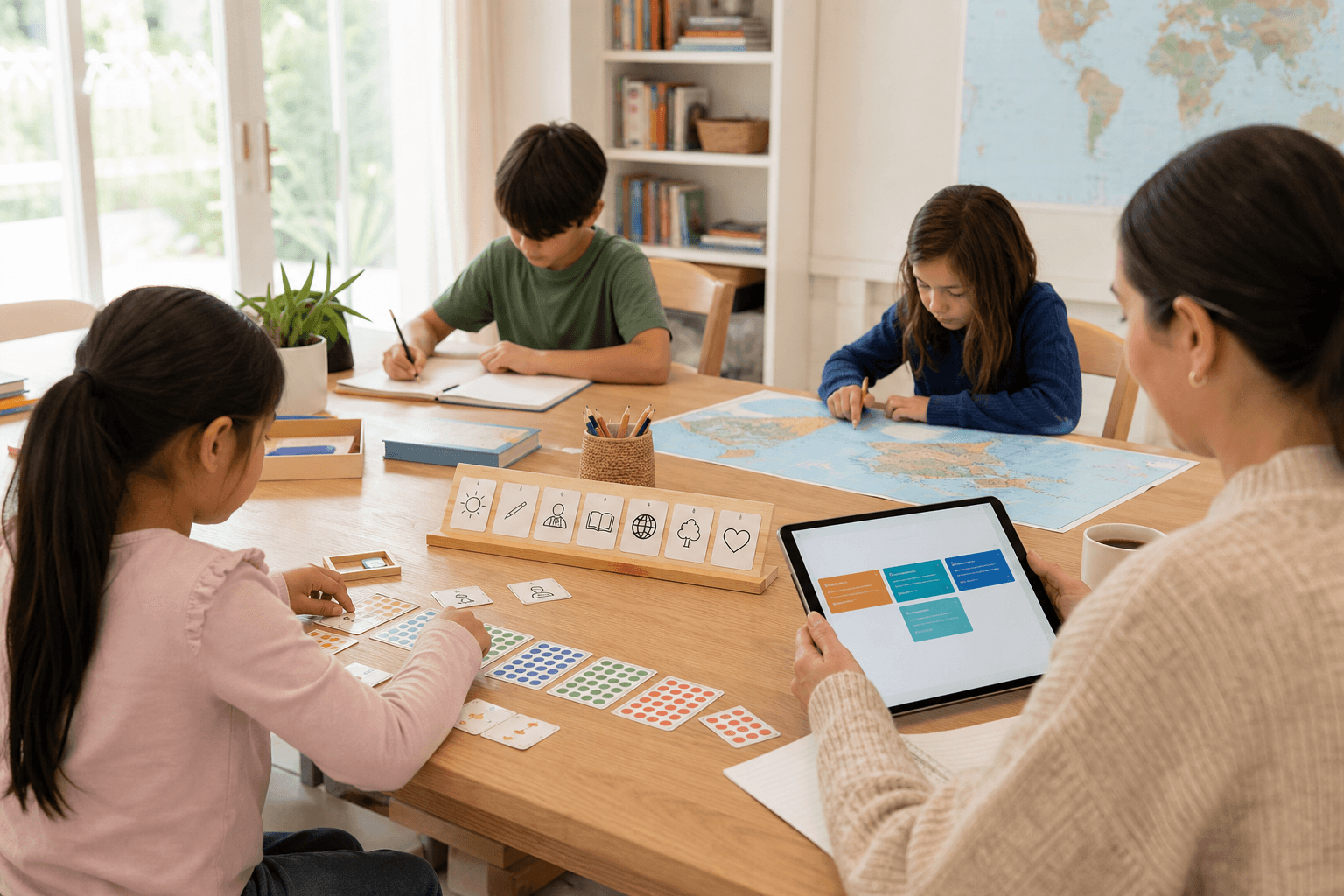
A family learning pod can be helpful when several homeschooling or worldschooling families want community, accountability, and shared energy. The mistake is trying to rebuild a small school with the same pressure, same pace, and same paperwork that did not fit in the first place.
The stronger model is shared rhythm with individual lanes. Families can open together, choose a common focus block, let each child work at the right level, and close with one visible proof point: an explanation, a solved task, a project photo, a reading note, or a portfolio reflection.
That matters for mixed-pace pods. One child may be gifted in mathematics, another may need shorter ADHD-friendly loops, another may need predictable transitions, and another may be learning across languages while moving between countries. A shared table does not require one identical assignment.
SchoolQuest AI fits inside the Little AI Minds Universe as the structured learning rhythm for this kind of pod: weekly rhythm, mastery checks, parent review, subject balance, and portfolio evidence stay organized even when the room has different children and different goals.
The parent boundary still matters. A pod is not an accredited-school promise, legal compliance service, therapy plan, or unsupervised childcare model. Parents still need local rules, wellbeing, supervision, and clear agreements. AI should make coordination calmer, not remove adult responsibility.
A simple pod week could use SchoolQuest AI for three shared anchors: core academic missions, a world or science context block, and a portfolio close. When the group has finished the structured learning loop and wants a bigger creative AI project, the SchoolQuest AI + Little AI Minds family-bundle path is the natural next step.
That is the useful balance: community without classroom pressure, flexibility without chaos, and evidence without turning every parent into a full-time administrator.
Next decision
Turn a guide into a concrete family step
Choose the next route based on what you are deciding now: a first calm week, complete Grade 1-6 coverage, family fit before an invitation, or phone/tablet use for gifted/high-IQ, ADHD, autistic, 2e, and mixed-pace learners.
Start with one calm week
Use the starter guide when your family needs a practical rhythm for attention, confidence, sensory load, and different learning paces before changing everything.
Open starter guideCheck full primary coverage
Open the program map when you need to see how math, reading, writing, science, geography, projects, life skills, and portfolio evidence fit together.
Open program mapUse both apps as one family path
Use SchoolQuest AI for weekly rhythm, mastery checks, records, and parent review. Add Little AI Minds when core learning is done and a bigger creative AI project makes sense.
See the family bundle pathDecide whether SchoolQuest fits now
Review the fit signals families should understand before joining: High-IQ, ADHD, autism, 2e, mixed learning styles, boundaries, help rhythm, and what should be clear before any paid access.
Review family fitTry the app surface on devices
Use the install page when you want the learning area and parent view on a phone or tablet while articles, pricing, and legal information stay in the browser.
Open install guideAI Homeschooling Starter Guide
Get the starter guide
Join the guide list and we will use this interest signal to send the right next steps.